Fees and Comparisons
OKX vs Bybit for Beginners (2026): Fees, Safety and Which to Pick
OKX and Bybit side by side: spot and futures fees from the official schedules, what a $1,000 trade costs on each, proof of reserves, the 2025 Bybit hack, which countries each one excludes, and how to choose.
Short answer: for a beginner who buys and holds on spot, OKX is slightly cheaper than Bybit on limit orders and the same on market orders. At regular-user rates OKX charges 0.08% maker / 0.10% taker on spot, and Bybit charges 0.10% / 0.10%. On perpetual futures the gap is also small: 0.02% / 0.05% on OKX against 0.02% / 0.055% on Bybit. That is well under a dollar per $1,000 traded, so for most people the deciding factors are whether the exchange serves your country, how you will deposit and withdraw, and how comfortable you are with each one's security record.
Fees and rules below were checked on the exchanges' official pages on November 16, 2026. They can change and can differ by region, so open the linked sources again before you trade. If you are weighing OKX against Binance instead, see our OKX vs Binance comparison.
OKX vs Bybit at a glance (checked November 16, 2026)
| What you are comparing | OKX | Bybit |
|---|---|---|
| Spot fee, regular user (maker / taker) | 0.08% / 0.10% | 0.10% / 0.10% |
| Perpetual and futures fee, regular user (maker / taker) | 0.02% / 0.05% | 0.02% / 0.055% |
| Who pays the regular rate | Assets under $100,000 or 30-day trading volume under $1,000,000 | Non-VIP accounts. Lower rates come with VIP levels |
| Proof of reserves | Monthly reports verified with zk-STARK. You can check that your balance is included | Merkle tree reports. You can check that your balance is included using your own Merkle leaf |
| Largest security incident | No customer-fund theft on the scale of the Bybit incident that we are aware of | About $1.5 billion in ETH stolen from a cold wallet on February 21, 2025 |
| Where it does not serve users | Varies by region. Some regions use a separate local version with its own fees and product list | Its service agreement excludes several jurisdictions, including the United States, mainland China, Hong Kong, Singapore and Canada |
| Identity verification (KYC) | Both ask for identity verification before you can use most features. Accepted documents depend on your country | |
Sources: OKX global fee framework, Bybit fees you need to know, OKX proof of reserves, Bybit service restricted countries.
OKX vs Bybit fees on a $1,000 trade
Percentages are easier to compare in dollars. Here is the trading fee alone on $1,000, at the regular-user rates above:
| Order | OKX | Bybit |
|---|---|---|
| Spot market order (taker) | $1.00 | $1.00 |
| Spot limit order that waits on the book (maker) | $0.80 | $1.00 |
| $1,000 perpetual position, opened and closed with market orders | $1.00 ($0.50 + $0.50) | $1.10 ($0.55 + $0.55) |
| $1,000 perpetual position, opened and closed with limit orders | $0.40 | $0.40 |
A market order fills right away, so it pays the taker fee. A limit order that sits on the order book until someone fills it pays the maker fee. On futures, the fee is charged on the full position value, not on the margin you put up: $100 of margin at 10x leverage is a $1,000 position and pays fees on $1,000.
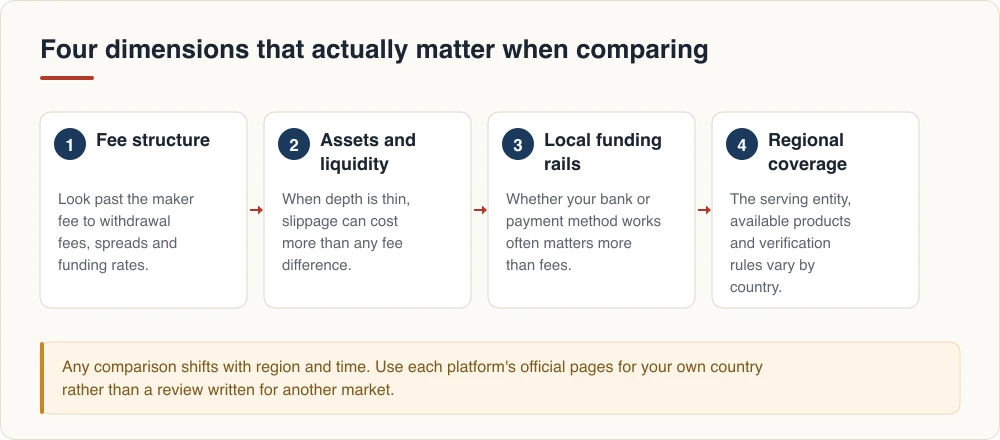
The gap between OKX and Bybit is small. Costs that the headline rate leaves out are usually bigger:
- Spread on "Buy" and "Convert" screens. These screens often build the cost into the price instead of showing a fee. Compare how much coin you actually receive.
- Card and third-party payment fees. Buying with a card can cost several times the trading fee.
- Withdrawal fees. These depend on the coin and the network you pick, not on the exchange's trading rate.
- Funding payments on perpetuals. At each funding interval, longs pay shorts or the other way round. Over several days this can outweigh the trading fee.
For a full breakdown of OKX's costs, see our OKX fees guide and the OKX fee schedule.
Is OKX or Bybit safer after the 2025 Bybit hack?
On February 21, 2025, attackers stole about $1.5 billion in ETH from one of Bybit's Ethereum cold wallets during a routine internal transfer. The FBI attributed the theft to North Korea. It is the largest crypto theft on record. Bybit said customer assets remained backed 1:1 and kept processing withdrawals while it replaced the lost ETH.
What this means for a beginner:
- No exchange is risk-free. Both OKX and Bybit hold customer funds, and both can be targeted. Keep only what you are actively trading on any exchange, and move long-term holdings to a wallet you control.
- Proof of reserves helps, but has limits. Both publish reserve reports and let you confirm your own balance is counted. A report shows assets at one point in time; it does not show every debt the company has.
- Your own account setup matters more day to day. Most individual losses come from phishing, reused passwords, leaked 2FA codes and fake apps, not from exchange hacks.
Whichever you pick, turn on the same controls before you deposit:
- Two-factor authentication with an authenticator app, not SMS alone.
- An anti-phishing code, so you can tell real exchange emails from fakes.
- A withdrawal address allowlist.
- Device management and login alerts.
Our OKX account security checklist shows where each setting is.
Can you use OKX or Bybit in your country?
Availability is a filter, not a feature. Check it first: the cheaper exchange is no help if it cannot open an account for you.
- Bybit lists excluded jurisdictions in its service agreement. As of November 2026 these include the United States, mainland China, Hong Kong, Singapore and Canada, among others. Some countries are served by a separate local Bybit entity with a different product list.
- OKX runs separate regional versions in some markets (for example the EEA, Singapore and Australia), each with its own fee framework and products. Not every pair or product is offered everywhere.
Read each exchange's official terms for your country, and confirm you can complete identity verification with your own documents. Never use a VPN or someone else's identity to get around a restriction: the account can be frozen and the funds held. For OKX, see Is OKX available in my country?.
OKX vs Bybit for futures, copy trading and bots
Both exchanges are known for derivatives. Both offer perpetual futures, copy trading and trading bots, and their regular futures fees are close. For a beginner, the more useful question is whether you need these products at all.
- Futures and margin let you lose more than you would on spot, and faster. Liquidation can close a position before the price comes back.
- Copy trading copies someone else's risk. Past returns on a leaderboard do not tell you how large their losing trades were.
- Bots such as grid bots follow fixed rules. They do not protect you when the price leaves the range you set.
If you are tempted by leverage, read our spot vs futures risk guide first. Start on spot with small amounts until you understand fees, networks and withdrawals.
OKX vs Bybit beyond trading fees: P2P, demo trading and accounts
Many "Bybit vs OKX" questions are not about the trading fee at all. People want to know how to buy their first USDT with local currency, whether they can practise without real money, and how the account is organised. Here is how the two compare on those points, checked on the official help centers on November 27, 2026.
| What you are comparing | OKX | Bybit |
|---|---|---|
| P2P fee when you buy or sell from an existing ad | No OKX service fee | 0% on most local currencies. Bybit lists a 0.25% service fee for takers on USD, EUR and AZN pairs |
| P2P fee for people who post ads | No OKX service fee | 0% to 0.30%, depending on the currency and the advertiser's level |
| Bank or payment app fees on P2P | Possible on both. Your bank or payment provider can charge its own fee, which the exchange does not show in its rate | |
| Demo trading with simulated funds | Yes, for spot and derivatives, switched on from the Trade menu | Yes, for spot and derivatives in the Unified Trading Account. The demo account starts with 50,000 USDT, 50,000 USDC, 1 BTC and 1 ETH in test funds and does not need identity verification |
Sources: OKX: What's P2P trading?, P2P on Bybit: fees explained, Bybit demo trading FAQ.
Buying USDT with local currency on OKX or Bybit
If you pay in a currency where Bybit charges takers nothing, P2P costs the same on both exchanges as far as the platform fee goes. The real difference is the price in each ad. A seller asking 1% above the market rate costs you far more than any listed fee, so compare the amount of USDT you receive for the same local amount, not the fee line.
P2P also adds risks that normal trading does not have: you pay another person directly, and disputes usually come from the payment leg. Before your first trade on either exchange, read our P2P trading risk checklist. For a step-by-step first purchase on OKX, see how to buy USDT on OKX safely.
Practise with demo trading before you use real money
Both demo modes use live market prices, so they are a good way to learn where the order buttons are, how a limit order differs from a market order, and what liquidation looks like on a futures position. Two limits to keep in mind:
- Demo fills can be easier than real ones. In a fast market, a real market order may fill at a worse price than the demo showed.
- Demo losses do not hurt, so they do not teach you how you react when real money is falling. Start live trading with an amount you can afford to lose completely.
Test a small deposit and withdrawal before you commit
The moment that matters most is getting your money out. Before you hold a meaningful amount on either exchange:
- Deposit a small amount using the method you plan to use long term.
- Buy a coin or stablecoin with a market order and note what you received.
- Withdraw part of it to a wallet. Confirm the destination supports the network first; see our USDT network guide.
- Write down the withdrawal fee, how long it took, and any holds or limits the app showed.
If both exchanges are available to you, run the same steps on each and compare the amount that arrived. If a transfer gets stuck, this checklist helps you find which stage it is at.
OKX or Bybit: which to pick for your situation
- You buy and hold on spot with limit orders: OKX's 0.08% maker fee is lower than Bybit's 0.10%. On $1,000 that saves $0.20.
- You only use market orders on spot: both charge 0.10%. Decide on availability, deposit method and the security record you are comfortable with.
- You trade perpetuals with market orders: OKX's 0.05% taker fee is slightly lower than Bybit's 0.055%. Funding payments and your own risk control matter far more.
- You live somewhere Bybit excludes, such as the United States, mainland China, Hong Kong, Singapore or Canada: Bybit is not an option. Check whether OKX or its local version serves you.
- You are worried about exchange risk: check each exchange's latest reserve report, keep only trading funds on the exchange, and hold the rest in a wallet. Our guide to withdrawing USDT from OKX to a personal wallet shows the checks to make.
Decision checklist
Choose only when you can answer all of these:
- Is the exchange available in my country?
- Can I complete KYC truthfully?
- Which exact product will I use: spot, convert or futures?
- What did my small test cost from deposit to withdrawal?
- Which network will I use for deposits and withdrawals?
- Which security settings will I enable before funding?
- How do I get help or recover the account?
About referral links
A referral benefit should be a last check. If you decide on OKX, confirm code OK6667 and whatever OKX currently shows on its sign-up page. If no benefit is shown, do not assume one applies. See the referral code guide.
Create your OKX account (code OK6667)
Disclosure: XSNeo is independent from OKX, Bybit and any other exchange mentioned. We may earn a commission if you register through this link, at no extra cost to you. Rewards are subject to OKX's official terms. See our affiliate disclosure and risk disclosure.
FAQ
Is OKX or Bybit cheaper?
For regular users, OKX is slightly cheaper. On spot, OKX charges 0.08% maker and 0.10% taker, while Bybit charges 0.10% for both. On perpetual futures, both charge 0.02% maker, and the taker fee is 0.05% on OKX against 0.055% on Bybit. These are official rates checked on November 16, 2026, and they can differ by region.
Is Bybit safe to use after the 2025 hack?
Bybit lost about $1.5 billion in ETH from a cold wallet on February 21, 2025. It said customer assets remained backed 1:1 and kept processing withdrawals. Bybit and OKX both publish proof of reserves. Whichever you use, keep only trading funds on the exchange and turn on 2FA, an anti-phishing code and a withdrawal allowlist.
Can I use Bybit or OKX in the United States?
Bybit's service agreement lists the United States as an excluded jurisdiction, along with mainland China, Hong Kong, Singapore, Canada and others. OKX serves some regions through separate local versions. Check each exchange's official terms for your country before you sign up.
Which is better for a beginner who only wants to buy and hold?
If both are available to you, their spot fees are close: OKX is $0.20 cheaper per $1,000 on limit orders and the same on market orders. Pick the one with a deposit and withdrawal route you trust, and move long-term holdings to your own wallet.
Is OKX or Bybit better for buying crypto with local currency?
OKX charges no service fee on P2P. Bybit charges takers nothing on most local currencies but lists a 0.25% taker fee on USD, EUR and AZN pairs. The price in each ad usually matters more than the fee, so compare how much USDT you receive for the same amount. Checked on November 27, 2026.
Can I open accounts on both OKX and Bybit?
Yes, if both are available to you. Each needs its own verification and security setup, so open only what you will use.
Does a referral link change what I can access?
No. It does not remove verification or make a restricted region eligible.
Bottom line
OKX is slightly cheaper than Bybit at regular-user rates, but the difference is cents per $1,000. Decide by whether the exchange serves your country, what a small real deposit and withdrawal costs you, and which security controls you will switch on before funding.
Digital assets are volatile and high risk. This article is educational and is not financial, legal or tax advice.