
OKX Guides
How to Withdraw from OKX to a Bank Account: Routes, Checks, and Delays
Getting money from an exchange balance into a bank account involves a currency conversion and a payment route, each with its own failure modes. This guide covers the available routes, the name-matching rule, and why transfers get delayed.
Reviewed 24 September 2026. Available cash-out routes, limits, fees and processing times differ by country and by verification level, and they change. Confirm what your own account offers before starting.
Moving money from an exchange balance into a bank account is really two operations stacked together: converting crypto into a currency your bank accepts, and then moving that currency through a payment route. Most problems people describe as "my withdrawal is stuck" are actually one of those two halves failing, and the fix depends on which.
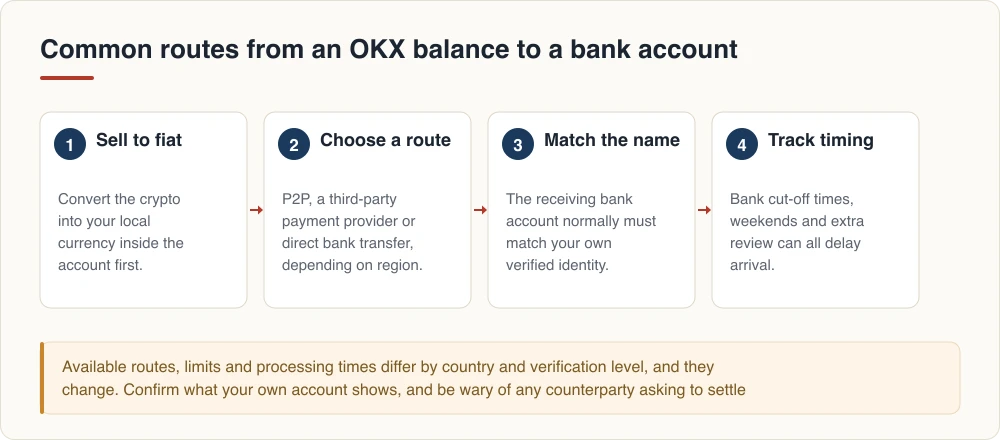
The routes, and how they differ
| Route | How it works | Main risk |
|---|---|---|
| P2P marketplace | You sell to another user who pays your bank directly | Counterparty and payment disputes |
| Third-party payment provider | An integrated provider handles the payout | Provider limits and coverage |
| Direct bank transfer | Fiat leaves the platform to your bank | Availability is region-dependent |
| Card payout | Paid to a linked card | Often lower limits, higher fees |
Which of these you actually see depends on your country and verification level. Not every route exists everywhere, and a guide written for another market will list options you cannot use.
Step one: convert to fiat inside the account
Before anything can reach a bank, the crypto has to become the currency your bank holds. Do that conversion inside the account first and confirm the resulting fiat balance before you start a withdrawal. Trying to run the conversion and the payout as one blurred step is what leaves people unsure which half failed.
Check the fee structure at this stage rather than after. Conversion, the payout route, and any intermediary bank can each take a cut, and the total is usually clearer before you commit than in the transaction history afterwards.
Step two: the name on the bank account must match
This is the single most common reason a payout is rejected or frozen. The receiving bank account normally has to be in the same name as the verified identity on the exchange account. Paying out to a spouse's account, a business account, or a friend's account will usually fail compliance checks even when the intent is entirely innocent.
If your legal name has changed, update the account records before attempting a withdrawal rather than after one gets held. Fixing a rejected payout takes considerably longer than updating a name field in advance.
Step three: understand what makes it slow
A transfer that has not arrived is not necessarily a transfer that has failed. Ordinary causes of delay include:
- Bank cut-off times. A payout submitted after the daily cut-off is processed the next business day.
- Weekends and public holidays. Domestic banking rails do not settle continuously, and holiday calendars differ between the sending and receiving country.
- Additional review. Larger amounts, a first withdrawal, or a recently changed security setting can all trigger manual checks.
- Security holds. Many platforms delay withdrawals for a period after a password or 2FA change, which is a protection rather than a fault.
Give a transfer a full business day before treating it as a problem, and check the withdrawal history for a status message before contacting support.
If you use P2P, treat it as its own risk
P2P is the route with the most active fraud, because it puts you in direct contact with a counterparty. A few rules cover most of it:
- Never release the crypto until the money is confirmed in your bank account. Not a screenshot, not a pending notification — actually credited and available.
- Stay inside the platform's escrow and chat. Any request to move to a messaging app is a strong warning sign, because it removes the record and the dispute process.
- Be careful with third-party payments. If the money arrives from an account with a different name than the counterparty, it may later be reported as fraudulent and reversed, and your bank account can be frozen as part of that investigation.
- Do not accept overpayment and refund the difference. This is a standard scam pattern.
The common crypto scams guide covers the P2P patterns in more depth.
Before you start
Check the current limits and available routes on your own account page, make sure identity verification is fully complete rather than partially done, and confirm the receiving account details independently. If a withdrawal is already stuck, the pending or failed withdrawal checklist works through the diagnosis step by step.
One more thing worth planning for: cashing out is usually a taxable event, and the rules vary widely by country. Keep records of the conversion rate and date at the time of sale rather than reconstructing them later.
Official sources
- OKX: how do I make a withdrawal
- OKX Help Center: deposit and withdrawal FAQ
- OKX: what is P2P trading
This article is operational guidance and does not constitute investment, legal or tax advice. Available routes and regulatory treatment differ by country and change over time. Some links on this site may be referral links.