Compliance and Risk
Is OKX Safe? Proof of Reserves, Licensing, and What to Verify Yourself
Safety is not a yes or no answer. This guide separates what an exchange publishes, what you can independently verify, what depends on your own region, and which risks no reserve report covers.
Reviewed 12 September 2026. Reserve reporting, supported regions and licensing arrangements change. Verify the current position on the official pages that apply to your own country before acting on anything here.
"Is this exchange safe?" is usually asked as a yes or no question, and it does not have a yes or no answer. A more useful framing separates four different things: what the platform publishes about itself, what you can check independently, what depends on where you live, and what remains your own responsibility no matter how the platform is run.
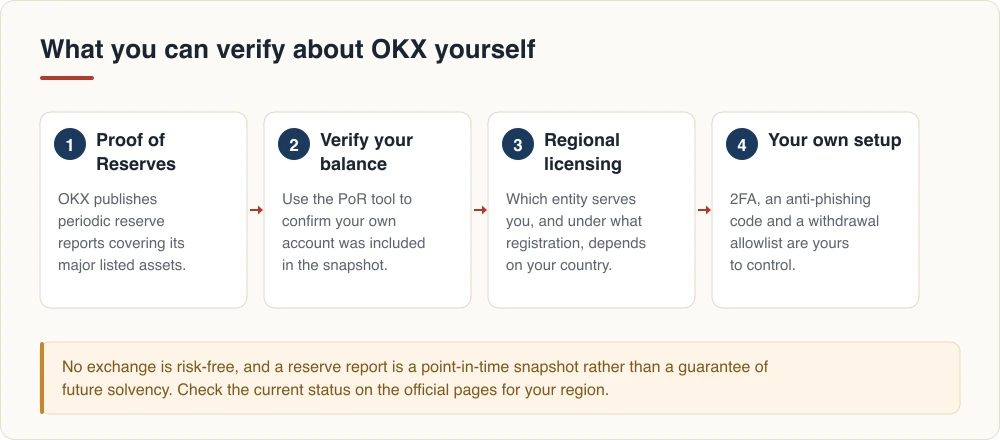
Four separate questions
| Question | Who answers it | How you check |
|---|---|---|
| Does the platform hold the assets? | Published reserve reports | Proof of Reserves page |
| Was my balance included? | You, cryptographically | Self-verification tool |
| Is it authorised where I live? | Your local regulator | Official regional pages |
| Is my account itself secure? | You | 2FA, allowlist, device hygiene |
Proof of Reserves: what it does and does not prove
OKX publishes Proof of Reserves reports on a recurring cycle, covering its major listed assets. The mechanism compares the total balances credited to user accounts against assets held in the exchange's on-chain wallet addresses, with the goal of demonstrating that user holdings are backed rather than lent out.
The verification uses zero-knowledge cryptography, which lets an individual user confirm that their own balance was included in the total without the platform revealing other users' amounts. That is a genuine improvement over simply publishing a wallet address and asking people to trust the total.
It is important to be precise about the limits, because this is where most coverage overstates things:
- A reserve report is a snapshot at one moment. It says nothing about the position the day after.
- It shows assets, not liabilities owed elsewhere. An exchange can hold reserves and still have obligations that the report does not surface.
- Coverage is limited to the assets included in that report, which is not necessarily everything you hold.
- Verification proves inclusion, not that you could withdraw at any given moment.
None of that makes Proof of Reserves worthless. It makes it one input rather than a guarantee.
Verify your own balance instead of trusting a summary
The part most people skip is the one that actually applies to them. Rather than reading a headline reserve ratio, log in and use the self-verification tool to confirm your own account appeared in the snapshot with the correct balance.
This takes a few minutes and is the only step in the whole process that produces evidence about your money specifically. If you keep a meaningful balance on any exchange, doing it after each published report is a reasonable habit.
Licensing depends entirely on your region
There is no single global answer to whether OKX is authorised, because the entity serving you, the products you can access, and the regulator responsible all vary by country. Some regions have full local registration, some operate under a different entity, and some are not served at all.
This matters more than most people assume. Which entity holds your account determines what recourse exists if something goes wrong, what protections apply to fiat balances, and whether the product set you read about elsewhere is even available to you. A review written for one country can be actively misleading in another.
Check the official regional page for your own country rather than relying on a general claim, and treat any article that gives a single worldwide licensing answer with suspicion. Whether the platform serves your region at all is covered in checking availability before signing up.
The risks that stay with you
A well-run platform does not protect you from the most common ways beginners actually lose money:
- Phishing sites and fake apps. Reached through search ads, social posts or messages, these capture credentials on a convincing clone. An anti-phishing code helps you recognise genuine platform emails.
- Account takeover. SMS-based codes are weaker than an authenticator app. A withdrawal allowlist limits the damage even if someone gets in.
- Social engineering. No legitimate support team asks for your password, seed phrase, or one-time codes, and none will ask you to move funds to a "verification address".
- Market and product risk. Leverage and derivatives can lose money quickly regardless of how sound the custodian is.
The account security checklist walks through the settings that address the first three.
A reasonable position
Treat published reserve data as useful but partial evidence, verify your own inclusion rather than accepting a summary, confirm the regional arrangement that applies to you specifically, and keep only what you need for active use on any exchange rather than treating it as long-term storage. Self-custody moves a different set of risks onto you, but it removes counterparty risk entirely, and for balances you are not actively trading that trade-off is often worth making.
Official sources
- OKX Proof of Reserves
- OKX Help Center: Proof of Reserves FAQ
- OKX: verifying ownership and balance of a wallet address
- OKX: PoR user snapshot data explained
This article is educational and does not constitute investment, legal or tax advice. No exchange is risk-free, reserve reports are point-in-time and do not guarantee future solvency, and crypto assets carry high risk including total loss. Some links on this site may be referral links.