
Crypto Beginner
What Is USDT? A Beginner's Guide to Stablecoins and Their Risks
USDT is the asset most beginners hold first without ever asking what backs it. This guide covers how the peg works, who maintains it, why the same token exists on many chains, and what a de-peg actually means.
Reviewed 6 October 2026. Reserve composition, attestation practices and the chains a token is issued on all change over time. Check the issuer's and the platform's current disclosures rather than relying on any article.
Most people who buy crypto end up holding USDT before they ever ask what it actually is. It behaves like a dollar inside an exchange, so it feels like cash. It is not cash, and the difference matters mainly when something goes wrong.
What a stablecoin is trying to do
| Question | Short answer |
|---|---|
| What is it pegged to? | It aims to track the US dollar one-to-one |
| Who maintains the peg? | The issuing company, not a blockchain rule |
| What gives it value? | The reserves the issuer holds against tokens in circulation |
| Is the peg guaranteed? | No — it is a target, not a law of the system |
That last row is the part beginners most often miss. Bitcoin's supply schedule is enforced by the protocol itself. A stablecoin's peg is a commitment made by a company, backed by assets that company says it holds. Those are very different kinds of promise.
How the peg actually works
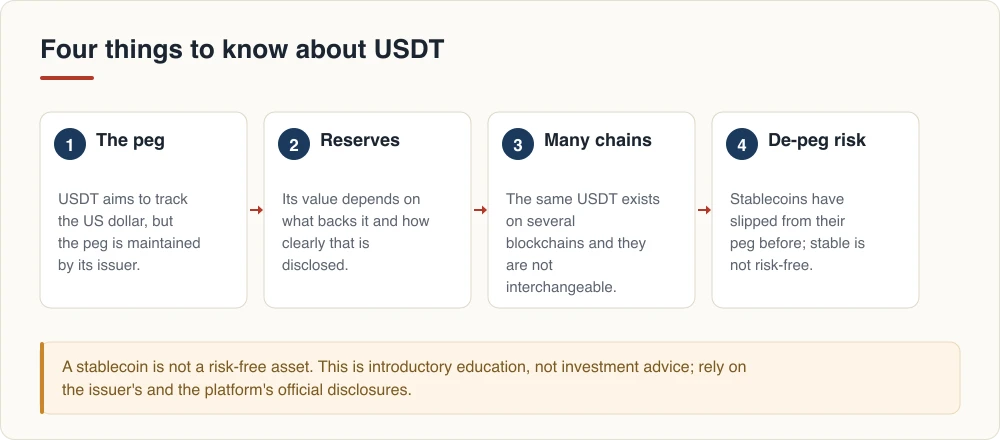
The issuer creates tokens when someone deposits dollars and destroys them on redemption. If the market price drifts below the peg, arbitrageurs can buy cheap tokens and redeem them at face value, which pushes the price back up. If it drifts above, the reverse.
That mechanism only works while redemption is genuinely available and the reserves genuinely exist. When either of those is in doubt, the arbitrage that holds the peg together weakens, which is exactly when de-pegs happen.
Reserves and disclosure
The value of a stablecoin comes down to what backs it and how clearly that is disclosed. Reserves can be held in cash, short-term government debt, commercial paper, or other assets with different liquidity and risk. A reserve made entirely of instruments that can be sold instantly is not the same as one holding assets that take time to liquidate.
Issuers publish attestations or reports on a recurring basis. Read what they actually cover: an attestation at a single point in time is a narrower statement than a full audit, and the composition can shift between reports. This is worth ten minutes of your own reading rather than trusting a summary.
The same token on many chains
USDT is issued on several blockchains. The token name is identical everywhere, but the networks are not interchangeable — sending on one chain to an address that only supports another is one of the most common ways beginners lose funds.
Before any transfer, start from what the receiving wallet or exchange supports and match the sending side to it. The USDT network guide covers how to choose, and the withdrawal walkthrough covers the address and Memo checks.
What a de-peg means for you
Stablecoins have traded away from their peg before, sometimes briefly and sometimes permanently. A small deviation during market stress is common and usually recovers. A sustained one signals that the market doubts the backing.
The practical implication is not to panic at every fraction of a cent, but to recognise that holding a stablecoin is holding an obligation of a company, not holding dollars in a bank. Diversifying which stablecoin you hold, and not treating any of them as a savings account, is a reasonable response.
What a stablecoin does not protect you from
- Exchange risk. A stable token in an exchange account is still subject to that platform's solvency and operations.
- Transfer mistakes. The peg does nothing about a wrong chain or a missing Memo.
- Yield products. Earning a return on a stablecoin means lending it to someone, which reintroduces the risk the peg was supposed to avoid.
- Regulation. Rules on stablecoins are still developing and differ sharply by country.
If you are new, the beginner buying checklist covers the practical side, and the account security checklist covers protecting what you hold.
Official sources
- OKX Help Center: deposit and withdrawal FAQ
- OKX: finding a deposit address and Memo/Tag
- OKX Risk and Compliance Disclosure
This article is introductory education and does not constitute investment, legal or tax advice. A stablecoin is not a risk-free asset, and crypto assets carry high risk including total loss. Some links on this site may be referral links.